

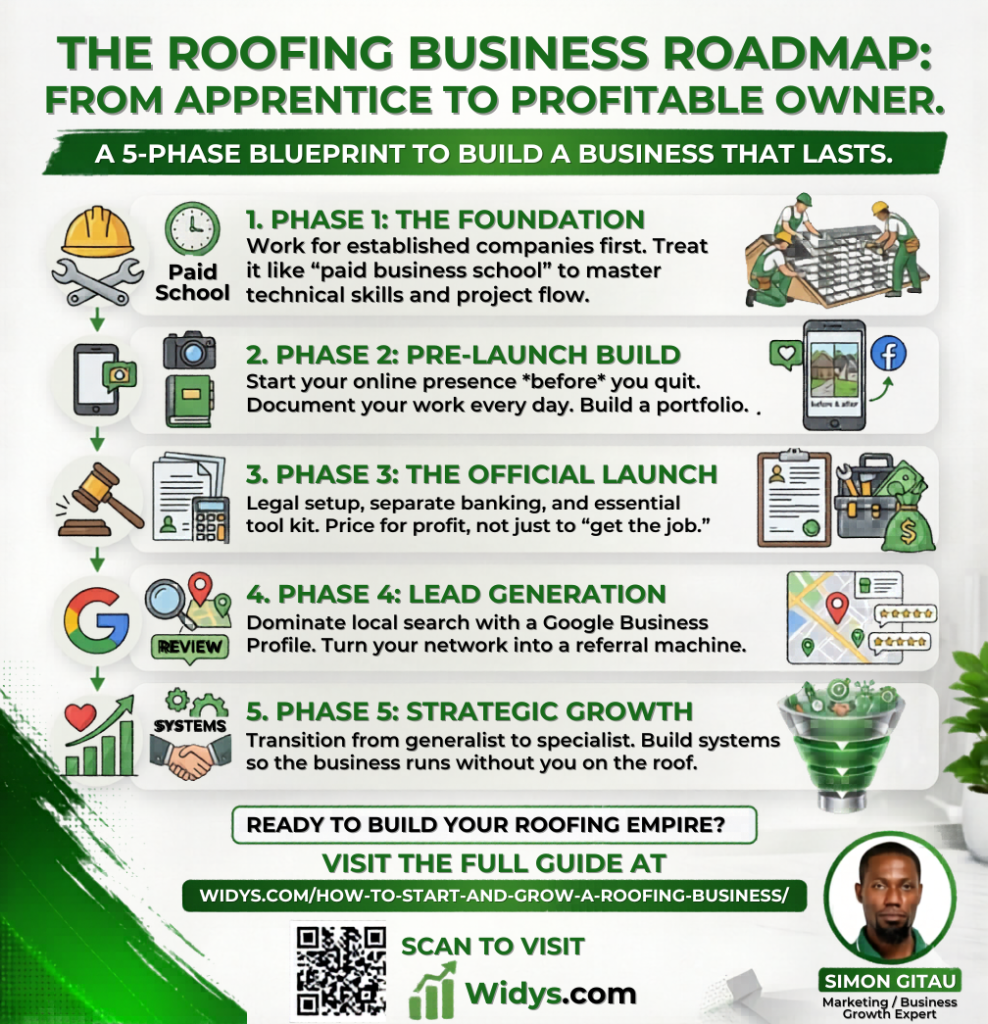
How to Start and Grow a Roofing Business: The Complete 5-Phase Guide
The roofing industry generates billions of dollars annually worldwide. Every day, homes need repairs, storms cause damage, and buildings require new roofs. It’s a trade that will never go out of demand.
Yet here’s the hard truth: most new roofing companies fail within the first three years.
Not because the owners couldn’t install shingles. Not because they didn’t work hard. They failed because they focused on roofing skills while ignoring business skills. They knew how to fix leaks but didn’t know how to price for profit, market effectively, or manage cash flow.
This guide exists to change that.
Whether you’re fresh out of trade school, an experienced roofer ready to start your own company, or an existing contractor struggling to grow, this 5-phase roadmap will show you exactly how to build a roofing business that lasts.
Here’s what you’ll learn:
- Why the best time to start marketing is before you open your business
- How to get clients without spending money on ads
- The specialization strategy that lets you charge more
- Common mistakes that kill roofing businesses (and how to avoid them)
- A realistic timeline from apprentice to successful business owner
Let’s begin.
Phase 1: Learn Before You Earn (The Foundation)
If you’re searching for how to start a roofing business, your first instinct might be to register a company, buy a truck, and start knocking on doors.
Please don’t.
The most successful roofing contractors took a different path. They spent 2-3 years working for others first—and got paid while learning.
Why Working for Others First Makes Sense
Think of it as paid business school. When you work for an established roofing company, you’re not just learning how to install roofs. You’re learning:
- How projects actually flow from first customer call to final payment
- How to estimate accurately (mistakes cost you nothing during this phase)
- How to handle problems when things go wrong (and they will)
- How to manage clients who are anxious, demanding, or difficult
- How to run a business without the risk of your own money on the line
The statistics back this up. According to the Bureau of Labor Statistics, about 20% of small businesses fail in their first year, and 50% fail within five years. The number one reason? Lack of experience in the industry.
What to Learn in Your First Roofing Job
When you join a roofing company, don’t just show up and do the minimum. Show up with a learner’s mindset.
Technical skills to master:
- Proper tear-off techniques (safety and efficiency)
- Underlayment installation (different types for different roofs)
- Flashing details (this is where most leaks start)
- Different material types (asphalt, metal, tile, flat systems)
- Safety protocols that become habit
Business observations to make:
- How does the owner find new clients?
- How are estimates structured and presented?
- What happens when a client complains?
- How are materials ordered and managed?
- How are crews scheduled and supervised?
Keep a notebook. Write down what works and what doesn’t. You’re building your future business plan while someone else pays you.
The Two-Company Strategy
Here’s a strategy that separates successful future business owners from average workers:
First, work for a high-volume residential roofer (6-12 months).
These companies do many roofs quickly. You’ll learn speed, efficiency, and how to handle multiple jobs. You’ll see how they price competitively and move crews from site to site. You’ll learn the bread-and-butter work that pays the bills.
Second, work for a specialty or commercial roofer (12-18 months).
After you understand basic residential roofing, go learn something different. Flat roofing systems (TPO, EPDM, modified bitumen). Metal roofing (standing seam, architectural). Tile or slate. Complex flashing details. Commercial projects with different requirements.
Why this combination matters: A roofer who only knows basic shingle installation on simple roofs is replaceable. A roofer who understands multiple systems and can handle complex details becomes the person other contractors call for help. When you eventually start your own business, you’ll be able to take jobs that competitors can’t.
How This Phase Answers “How to Start a Roofing Business”
The foundation of how to start a roofing business isn’t paperwork—it’s knowledge. By the end of this 2-year learning phase, you’ll know:
- What kind of roofing you want to specialize in
- How much money you need to save before launching
- What tools you’ll actually need (versus what you thought you needed)
- How the business side actually works
You haven’t started your business yet. But you’re building the foundation that will make it successful when you do.
Phase 2: Build Your Future While Employed
This is the phase that most future business owners completely miss. They work for someone else for a few years, then quit and suddenly realize they have no clients, no portfolio, and no online presence.
The smartest roofers start building their future business while still employed.
The Documentation Strategy
Every single day you’re on a roof, you’re surrounded by marketing material. But only if you capture it.
With your employer’s permission, start documenting your work:
- Before photos of damaged or old roofs
- During photos showing the process (tear-off, underlayment, flashing details)
- After photos of completed work from multiple angles
How to ask permission: “I’m building a portfolio for my future career. Is it okay if I take photos of my work here? I’ll never share anything that makes the company look bad, and I’m happy to send you any photos you want for your own marketing.”
Most employers will say yes. It costs them nothing, and it shows you’re serious about your craft.
Start Your Online Presence Early
While you’re still employed, create simple social media accounts:
Facebook Page: “[Your Name] | Roofing Professional” or “Learning the Roofing Trade with [Your Name]”
Instagram: Same name, focused on visual work
What to post to Grow a roofing business (2-3 times per week):
- “Day 47: Learning how to properly flash around a brick chimney. The detail work is what stops leaks.”
- “Completed this tear-off today. Three layers of old shingles. Satisfying to get down to clean decking.”
- “Different roof systems today—installing TPO on a commercial building. Flat roofing requires completely different techniques.”
- “Before and after: This roof had active leaks for years. Now it’s sealed and ready for decades of service.”
What’s happening: You’re not selling anything. You’re not asking for clients. You’re simply showing up online as someone who takes their trade seriously. Over 1-2 years, you’ll build an audience of 500, 1,000, or 2,000 people who are watching you become an expert. We have a guide of content marketing for contractors. It shows what to post and when to post. I also have a video on how to increase customer touch points. Check it out.

When you eventually start your own company, you won’t have to introduce yourself. They’ll already know you, trust you, and remember watching your journey.
Save Money With Purpose
This phase gives you something freelancing doesn’t: consistent income.
Calculate your monthly living expenses. Multiply by 6. That’s your target savings before you leave your job.
Why 6 months? The first months of any roofing business are unpredictable. Payments get delayed. Weather stops work. Materials cost more than expected. A client might be late paying. Having savings means you never accept a bad client out of desperation.
To grow your roofing business, start buying tools gradually:
- Quality roofing hammer
- Nail gun (cordless if possible)
- Chalk line and tape measure
- Tin snips
- Safety harness and equipment
- Good ladder
Check Facebook Marketplace, Craigslist, and local tool sales. Used tools in good condition can save you thousands.
How This Phase Answers “How to Get Clients for My Roofing Business”
To grow your roofing business, you need a steady flow of customers. To do that, you need an effective contractor marketing approach. Most people searching how to get clients for my roofing business are already struggling with an empty pipeline. By building your audience during employment, you solve this problem before it exists.
When you finally launch, you’ll have:
- A portfolio of quality work
- An audience of potential clients
- Proof that you’ve been learning for years, not days
- Savings to survive the slow months
Phase 3: How to Start a Roofing Business (The Launch)
You’ve completed 2-3 years of learning and sharing what you do during this time. You’ve built your online presence. You’ve saved your runway money. Now it’s time to make it official.
Legal and Financial Setup
To grow a roofing business, you need to set it up formally. Every location has different requirements, but these steps are universal:
Choose your business name. Keep it simple and descriptive. “[Your Name] Roofing” or “[Your City] Roofing Solutions” works well. Avoid clever names that don’t tell people what you do.
Register your business. Research your local requirements. This might be through your city, county, or national government. In the US, this often means registering with your state and getting an EIN from the IRS. In Kenya, this means registering a business name or company with the relevant authorities.
Get your tax ID number. This separates you as a business entity and lets you pay taxes properly.
Open a separate business bank account. This is non-negotiable. Mixing business and personal money is the fastest way to financial confusion and tax problems.
Get insurance. At minimum, you need general liability insurance. Depending on your location, you may need workers’ compensation insurance even if you’re solo (in case you hire later). Talk to an insurance agent who works with contractors.
Equipment Strategy for New Roofers
You don’t need everything on day one. Here’s what matters:
Essential (buy new or good used):
- Quality ladder (extension ladder appropriate for roof heights)
- Safety harness and anchors (never compromise on safety)
- Roofing nailer (cordless is more expensive but more convenient)
- Hand tools (hammer, tin snips, chalk line, utility knife, tape measure)
- Magnetic sweeper (for cleaning nails—protects your reputation and tires)
Nice to have (buy as jobs pay for them):
- Second ladder
- Air compressor (if you use pneumatic nailers)
- Generator (for jobs without power)
- Trailer for hauling materials
Vehicle decision: A brand new truck with expensive signage looks impressive. It also costs $50,000+ that could have been saved or invested. Start with a reliable used vehicle. Upgrade when the business can afford it easily.
How to Price Your First Jobs
One of the biggest barriers to growing a roofing business is poor pricing. Pricing is where new roofers make their biggest mistakes. Charge too little, and you’ll work yourself into bankruptcy. Charge too much, and you’ll have no work.
The simple formula:
(Estimated Material Cost) + (Your Labor Hours × Hourly Rate) + (10-20% Overhead) + (15-20% Profit) = Your Price
How to determine your hourly rate:
Research what other roofers in your area charge. If the typical crew charges $50-70 per hour, you might start at $45-50 as you build reputation. But never go below your costs.
Breaking down material costs:
- Get quotes from suppliers
- Add 10-15% for waste and unexpected needs
- Never guess—measure and calculate precisely
Common pricing mistakes:
- Forgetting to include disposal costs (old roof removal)
- Underestimating how long a job will take
- Not accounting for travel time
- Ignoring overhead (insurance, phone, vehicle maintenance)
- Bidding jobs you’ve never done before
For your first several jobs, track your actual time and compare it to your estimate. This is how you get better at pricing. You will not grow your roofing business if your pricing is not right. You will bleed cash and most certainly fail.
How This Phase Answers “How to Start a Roofing Business”
This section directly addresses the practical steps for how to start a roofing business—the legal, financial, and operational foundations that turn a skilled roofer into a legitimate business owner.
Phase 4: How to Get Clients for Your Roofing Business
This is the question that keeps new business owners awake at night: how to get clients for my roofing business.
The good news? You’ve already started. Your 2 years of documenting and posting means you’re not starting from zero.
Your First Clients Come From Your Network
Your social media audience: Those 500-2,000 people who’ve watched you learn? Many are homeowners in your area. Announce your launch. Offer a grand opening special. Ask them to share your page with friends.
Friends and family: Let everyone you know that you’re starting your own roofing business. Ask them to keep you in mind for referrals. Most people want to help—they just need to know you’re open for business.
Former colleagues: The people you worked with know your quality. They may refer clients they can’t take, or they may become your first subcontractors when you need help.
Real estate agents: Agents constantly need small repairs before home sales. A leaking roof can kill a deal. Introduce yourself to local real estate offices. Offer fast, reliable service for their repair needs.
Property managers: Apartment buildings and rental properties need ongoing maintenance. Property managers are always looking for reliable tradespeople.
Referrals will help you get started and most likely start doing well, but to grow a roofing business beyond this early success, you will need a structured marketing approach.
Google Business Profile (The Local Goldmine)
It is one of the easiest way to grow a roofing company. If you do nothing else for marketing, do this. A properly set up Google Business Profile is how local homeowners find roofers.
Set up your profile completely:
- Accurate business name, address, and phone number
- Service area (the neighborhoods you cover)
- Your best photos (at least 10-15)
- Business hours
- Services offered
Getting your first reviews:
Your first 5-10 reviews are critical. Ask your first clients directly:
“I’m just getting started with my own business, and reviews really help. If you’re happy with my work, would you mind leaving a quick review on Google? I’ll send you the link.”
Photo strategy:
Post new photos regularly. Every completed job should add to your profile. Google favors active profiles with fresh content.
Respond to every review:
Thank positive reviewers professionally. If you ever get a negative review, respond calmly and offer to make things right. Future clients watch how you handle problems.
Facebook Community Groups Strategy
Building a community is one of the most potent way of building and growing any contractor business fast. This is free and incredibly effective if done right.
Find local groups:
Search Facebook for:
- “[Your City] Community”
- “[Your Neighborhood] Residents”
- “[Your Area] Recommendations”
- “Things happening in [Your City]”
Join 5-10 active local groups.
Set up notifications:
Turn on notifications for these groups. When someone asks for roofer recommendations, you can respond quickly.
How to respond professionally:
Don’t just say “I can do it.” That looks desperate and unprofessional.
Instead, say this:
“Hi [Name]. I’m a roofer based in this area. I recently finished a similar repair in [Nearby Street] (see photo attached). I’m available to look at your roof and give a free estimate. You can see more of my work at [Link to your page].”
Then post a photo of relevant work in the comments. This proves you’re real and capable.
What not to do:
- Don’t post “I’m a roofer, hire me” in groups (spammy)
- Don’t argue with negative comments
- Don’t join groups just to post your services—be a helpful member first
Before/After Photos as Marketing
Visual proof beats any sales pitch. Every job you do, no matter how small:
- Take multiple before photos
- Take photos during the work
- Take clean after photos from the same angles
Where to share:
- Your Google Business Profile
- Your Facebook page
- Your Instagram
- In community group responses
- On a simple website (if you have one)
Over time, you build a visual catalog that proves your quality better than any words can.
Referral Systems That Work
Happy clients are your best marketing channel—if you ask them for help.
The simple ask:
“Mrs. Johnson, I’m so glad you’re happy with the roof. I’m building my business, and referrals mean everything. If you know anyone else who needs roofing work, I’d be grateful if you’d pass along my name.”
The thank-you:
When someone refers a client who hires you, send a small thank-you. A gift card, a bottle of wine, or even a handwritten note. It’s not about the value—it’s about showing appreciation.
Partner with complementary trades:
- Gutter installers
- Window companies
- Solar installers
- General contractors
- Home inspectors
These professionals see roofing needs regularly. Build relationships with them. Refer work their way, and they’ll refer work yours.
How This Phase Answers “How to Get Clients for My Roofing Business”
This entire section is a practical playbook for how to get clients for my roofing business—specific strategies that cost little to nothing and build over time.
Phase 5: How to Grow Your Roofing Business
You’ve launched. You’re getting clients. You’re paying your bills. Now you want to grow. This is where how to grow your roofing business becomes your focus.
The Specialization Path to Higher Profits
Here’s a truth about the roofing industry: general roofers compete on price. Specialists compete on value.
When you do everything, you’re replaceable. Any other roofer can do what you do. Clients shop around and choose whoever’s cheapest.
When you become known as the expert in one thing, clients seek you out specifically. They’re willing to pay more because they can’t find your expertise elsewhere.
Specialization options to consider:
Metal roofing specialist: Metal roofs are growing in popularity. They require different skills than shingles. Good metal roofers are hard to find.
Tile and slate specialist: These materials are expensive and require specific expertise. Mistakes are costly. Clients pay premium prices for proven experts.
Flat roofing specialist: Commercial buildings, apartments, and modern homes often have flat roofs. TPO, EPDM, and modified bitumen systems require different knowledge.
Historical restoration: Older homes with unique roofing requirements. If you learn to match historical materials and techniques, you’ll have little competition.
Storm damage specialist: Working with insurance claims requires specific knowledge of how to document damage and work with adjusters. This can be highly profitable.
How to choose your specialty:
- What’s in demand in your area?
- What do you genuinely enjoy doing?
- What can you become excellent at?
- Where is the competition weakest?
You don’t have to specialize immediately. But as you grow, moving toward specialization will increase your profits and reduce your competition.
Building Systems for Consistency
Growth without systems is chaos. If every job requires you to figure everything out from scratch, you’ll be exhausted and inconsistent.
Create templates for:
- Estimates (so you don’t reinvent the wheel each time)
- Contracts (that protect you and set clear expectations)
- Invoices (professional and consistent)
- Follow-up messages (asking for reviews, thanking clients)
Develop standard operating procedures:
- How do you handle initial client calls?
- What’s your process for measuring and estimating?
- How do you manage material delivery?
- What’s your daily job site routine?
- How do you handle change requests from clients?
When you document how you do things, you can:
- Do them consistently
- Improve them over time
- Teach them to employees later
Hiring Your First Employee
You’re getting more work than you can handle alone. It’s time to hire.
When to hire:
- You’re turning down good work
- You’re consistently working 60+ hours
- You have enough work to keep someone else busy
- You can afford to pay someone while you train them
Finding reliable workers:
- Ask trusted colleagues for recommendations
- Post in trade-specific Facebook groups
- Contact trade schools for recent graduates
- Consider starting with part-time help
Training your first employee:
You can’t expect someone to work exactly like you without training. Plan to:
- Work alongside them for the first several jobs
- Explain not just what to do, but why you do it that way
- Check their work regularly (but respectfully)
- Give feedback immediately and constructively
Paying your first employee:
Options include:
- Hourly wage (simplest for beginners)
- Daily rate (common in many countries)
- Per-job payment (for experienced workers)
- Combination (base plus bonus for quality/speed)
From Solo to Crew Leader
This is the hardest transition for many new business owners. You’ve been successful because you’re a great roofer. Now you need to become a great manager.
The mindset shift:
Your job is no longer roofing. Your job is managing people who roof. If you spend all your time on roofs, you won’t have time to find new clients, manage finances, or grow the business.
Quality control as you grow:
You can’t personally inspect every nail. But you can:
- Check completed work before client walkthroughs
- Take photos of work for your records
- Get client feedback after every job
- Address problems immediately
Maintaining client relationships:
Clients hired you because they trusted you. When you send employees, some clients may feel neglected. Introduce your team personally. Explain that you trust them and stand behind their work. Check in personally during and after the job.
Scaling to Multiple Crews
This is the level where how to grow your roofing business becomes about systems and leadership.
When to add a second crew:
- Your first crew is consistently busy
- You have enough work to keep them both busy
- You have a reliable crew leader you trust
- You’ve documented your systems well enough to teach them
Finding crew leaders:
Your best crew leader might be your first employee, trained well and ready for more responsibility. Or you might hire experienced roofers who can lead from day one.
Systems for estimating and production:
With multiple crews, you can’t estimate every job personally. You need:
- Estimating guidelines your crew leaders can follow
- Pricing structures that ensure profitability
- Quality checks that maintain standards
- Communication systems that keep everyone informed
Balancing growth with quality:
Growing too fast can destroy a good reputation. Add capacity only when you can maintain quality. It’s better to grow slowly and steadily than to expand quickly and fail.
How This Phase Answers “How to Grow Your Roofing Business”
This section provides the roadmap for how to grow your roofing business—from solo operator to crew leader to multi-crew company. Each stage requires different skills and systems.
Common Mistakes That Kill Roofing Businesses
Learn from others’ failures so you don’t have to experience them yourself.
Financial Mistakes
Not charging enough: You need to cover materials, labor, overhead, AND profit. Many new roofers charge only for materials and labor, then wonder why they’re broke at the end of the year.
Mixing business and personal money: This makes accounting impossible and taxes a nightmare. Keep them completely separate.
Ignoring taxes: The money you collect isn’t all yours. A portion belongs to the government. Put tax money in a separate account immediately.
Buying too much truck too soon: A $60,000 truck with payments doesn’t help you get work. A $15,000 used truck does the same job while you build your business.
Not saving for slow periods: Roofing is seasonal in many areas. Winter may be slow. Save during busy months to survive the quiet ones.
Operational Mistakes
Taking every job that comes along: Some clients are more trouble than they’re worth. Learn to recognize red flags: clients who argue about deposits, change requirements constantly, or want work you’re not qualified to do.
Poor safety practices: One serious accident can end your business and change your life forever. Invest in safety equipment and training. Never take shortcuts.
Inconsistent quality: Every job represents your brand. A rushed job that looks mediocre damages your reputation permanently. If you can’t do it right, don’t do it.
Late arrivals and missed appointments: Showing up late tells clients you don’t respect their time. Be early or on time, every time. If you’re delayed, communicate immediately.
Marketing Mistakes
Relying only on word of mouth: Word of mouth is great, but it’s slow and unpredictable. Combine it with the online strategies covered in Phase 4.
No online presence: In 2024, if you can’t be found online, you don’t exist to many potential clients. At minimum, have a Google Business Profile and Facebook page.
No photo documentation: You’re doing quality work, but if you can’t show it, clients can’t see it. Photos are your most powerful marketing tool.
Ignoring Google reviews: Reviews build trust. Actively ask happy clients to leave reviews. Respond to all reviews professionally.
Client Relationship Mistakes
Poor communication: Clients get anxious when they don’t know what’s happening. Update them regularly on progress, delays, and changes.
Not managing expectations upfront: If the job will take 5 days and will be noisy and messy, tell them before you start. Surprises create unhappy clients.
Handling complaints poorly: When something goes wrong (and it will), how you respond matters more than the problem itself. Listen, apologize sincerely, and fix it promptly.
Burning bridges with difficult clients: Even difficult clients have friends and family. Handle every situation professionally, even when you’re frustrated.
How to Market a Roofing Business on a Small Budget
You don’t need thousands of dollars for marketing. You need consistency and smart strategies.
Zero-Cost Marketing Strategies
Google Business Profile: Free, and it’s how local clients find you. Complete every section, add photos regularly, and respond to reviews.
Facebook community groups: Free, and highly effective when done right. Be helpful, not spammy.
Before/after photo posting: Free, and builds credibility over time. Post consistently on your page and in relevant groups.
Client review generation: Free, and builds social proof. Ask every happy client for a review.
Partnerships with real estate agents: Free, and can generate consistent referral work. Introduce yourself, leave business cards, follow up.
Partnerships with complementary trades: Free, and mutually beneficial. Refer work to them, and they’ll refer work to you.
Low-Cost Marketing That Works
Simple website: You can build a basic website for under $100/year. Include your services, photos, contact information, and testimonials. No need for expensive designers initially.
Local Facebook ads: You can start with $5-10 per day targeting homeowners in your area. Promote your best before/after photos or a seasonal special.
Yard signs: After completing a job, ask permission to leave a sign for a week or two. Future clients driving by will see your work and your name.
Vehicle magnets or decals: Your work vehicle is mobile advertising. Keep it clean and professionally marked.
Local networking groups: Many communities have business networking groups. The investment is usually just your time and membership fees (often minimal).
Content Marketing for Roofers
Creating helpful content positions you as an expert and helps clients find you online.
Topics to write or post about:
- How to tell if your roof needs repair or replacement
- Questions to ask before hiring a roofer
- Different roofing materials: pros and cons
- What to do after storm damage
- How to spot a leaking roof early
- Maintenance tips for extending roof life
Where to share:
- Your Facebook page
- Your website blog
- Local community groups (when relevant)
- As answers to questions people ask online
Frequently Asked Questions About Starting a Roofing Business
How much money do I need to start a roofing business?
This varies greatly by location and your existing equipment. A bare-bones startup might need:
- Basic tools: $500-1,500 (if buying used)
- Ladder: $200-400
- Safety equipment: $200-500
- Vehicle: $3,000-10,000 (used)
- Insurance deposit: $500-1,000
- Business registration: $50-200
- Initial marketing materials: $100-300
Total minimum: $4,500-14,000
Remember that you’ll also need living expenses for your first months. This is why Phase 2 (saving while employed) is so important.
Do I need a license to start a roofing company?
Requirements vary significantly by location:
- United States: Most states require contractor licensing. Some require specific roofing licenses. Check with your state’s licensing board.
- Kenya: You’ll need to register your business name and get relevant licenses from your county government.
- UK: Roofing contractors typically need to register as a business and may need specific certifications.
- Australia: Licensing requirements vary by state. Most require a contractor license.
Universal advice: Research your local requirements thoroughly before starting. Operating without required licenses can result in fines and legal problems.
How do I find my first roofing clients?
Your first clients come from:
- Your social media audience (built during Phase 2)
- Friends and family referrals
- Real estate agents needing small repairs
- Facebook community group responses
- Google Business Profile (once you have reviews)
Start with these strategies before spending money on advertising.
Should I specialize in one type of roofing?
Eventually, yes. Specialization allows you to:
- Charge higher prices
- Face less competition
- Become known as the expert
- Work on more interesting projects
However, when starting out, you may need to take various jobs to build cash flow. Aim to choose a specialty within your first 2-3 years.
How do I price my roofing services?
Use this formula:
(Materials + Disposal + Labor) × (1 + Overhead Percentage) × (1 + Profit Percentage) = Your Price
Example:
- Materials: $2,000
- Disposal: $300
- Labor (40 hours × $30/hour): $1,200
- Subtotal: $3,500
- Overhead (15%): $525
- Profit (20%): $700
- Total price: $4,725
Research local rates to ensure your prices are competitive. Track your actual hours and costs to refine your estimates over time.
How long does it take to build a profitable roofing business?
Realistic timeline:
- Year 1 in business: Modest income, building reputation, learning to estimate accurately
- Year 2: Growing client base, possibly hiring help, more consistent income
- Year 3: Established reputation, potentially profitable, considering specialization
- Year 4-5: Strong business with loyal clients, referrals, and growth options
Some grow faster; some grow slower. Focus on quality and consistency rather than speed.
Conclusion
Starting and growing a roofing business is a journey, not an event. The roofers who succeed long-term aren’t necessarily the most talented technicians. They’re the ones who:
- Took time to learn before risking their own money
- Built their audience before they needed clients
- Saved their runway before leaving employment
- Marketed consistently using free and low-cost strategies
- Specialized strategically to escape price competition
- Built systems that allowed them to grow
- Learned from mistakes (their own and others’)
Roofing is a skill. Business is a separate skill. Master both, and you’ll build a company that provides for you and your family for decades.
Your next steps:
- If you’re not yet roofing: Find a reputable company and start learning
- If you’re roofing for someone else: Start documenting your work and building your online presence today
- If you’re ready to launch: Complete your legal setup, set up your Google Business Profile, and announce your launch to your audience
- If you’re already in business: Choose one area to improve—marketing, pricing, systems, or specialization
What stage are you in? Learning? Employed? Just launched? Growing?
Drop a comment below and let me know. I’d love to hear about your journey and answer any questions you have about building your roofing business. 👇
Want more guides like this? Subscribe to my newsletter for weekly tips on starting and growing construction businesses.