

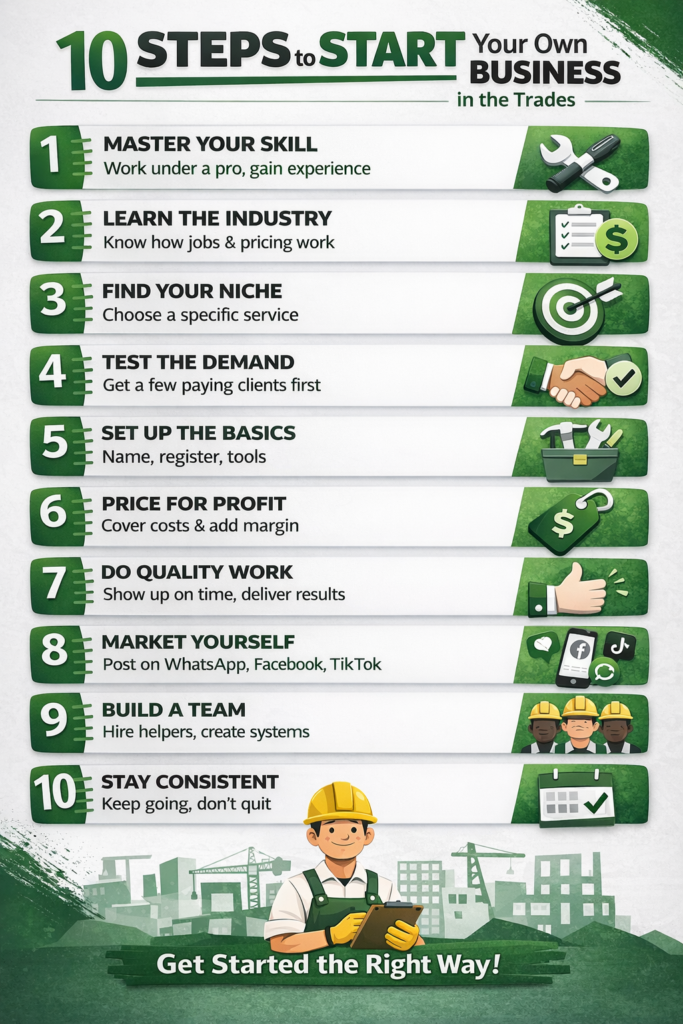
How to Start a Business (Step-by-Step Guide for Trades & Service Professionals)
Starting a business sounds exciting.
Be your own boss. Make more money. Build something of your own.
But here’s the truth most people won’t tell you:
Most businesses don’t fail — they never really start properly.
Especially in the trades and service space.
You’ll see a welder register a company before landing a single client.
An electrician print business cards before understanding pricing.
A stylist open a shop before building demand.
And within months, things slow down… then stop.
If you’re serious about learning how to start a business, especially as a contractor, technician, or service professional, this guide will walk you through what actually works — not theory, not motivation, but real-world steps.
Step 1: Master a High-Value Skill First
Before you think about names, logos, or registration…
Ask yourself one question:
“Am I really good at something people are willing to pay for?”
Every successful service business starts here.
Whether you’re:
- A roofer
- A mason
- A welder
- A plumber
- A hairstylist
- A technician
Your business is built on your ability to deliver results.
Why skill matters more than anything else
- Clients don’t pay for effort — they pay for results
- Referrals come from quality work
- Pricing power comes from confidence in your skill
If your work is average, your business will struggle — no matter how well you market it.
The smartest path (that most people skip)
Spend time working under someone experienced.
Not just to learn the trade — but to understand:
- How jobs are handled from start to finish
- How clients communicate
- What good work actually looks like
- What mistakes cost money
2–4 years of experience can save you 5+ years of struggle.
Step 2: Understand How the Industry Actually Works
Knowing your skill is not enough.
You also need to understand how money flows in your industry.
This is where most new business owners fail.
They know how to do the work — but not how the business side operates.
Things you must understand:
1. How clients are found
- Referrals
- Walk-ins
- Social media
- Site visibility
- Partnerships
2. How pricing works
- Market rates
- Negotiation habits
- Cheap vs premium clients
3. How jobs are executed
- Timelines
- Material sourcing
- Labor coordination
4. Where profit is made (and lost)
If you don’t understand these, you’ll:
- Underprice your work
- Attract the wrong clients
- Lose money without realizing
Don’t guess. Observe. Learn. Ask questions.
Step 3: Choose a Clear Service and Target Market
One of the biggest mistakes people make when starting a small business:
Trying to do everything.
“I do welding.”
“I do electrical.”
“I do construction.”
That’s too broad.
Clear positioning makes everything easier
Instead of:
- “I do welding”
Say:
- “I fabricate custom gates and grills for residential homes”
Instead of:
- “I’m a stylist”
Say:
- “I specialize in bridal makeup and events”
Why this matters
When your service is clear:
- Clients understand you faster
- You attract the right jobs
- Marketing becomes easier
- You can charge more
Ask yourself:
- What specific problem do I solve?
- Who do I solve it for?
That’s your starting point.
Step 4: Validate Demand Before You Register Anything
This step alone can save you from failure.
Before you:
- Register a business
- Rent a space
- Print materials
Ask: “Will people actually pay me?”
How to validate your business idea
Get your first 3–5 paying clients.
Not friends. Not free jobs.
Real paying clients.
This helps you test:
- Demand
- Pricing
- Your service delivery
Why this matters
Many people start businesses based on assumptions.
Then reality hits:
- Clients are fewer than expected
- Prices are lower than expected
- Work is inconsistent
Revenue first. Paperwork later.
Step 5: Set Up the Basics (Keep It Simple)
Once you’ve validated demand, now you can formalize your business.
But keep it simple.
You don’t need complexity to start.
Basic things you need:
- A business name
- Registration (as required in your location)
- A payment method (M-Pesa, bank, etc.)
- Essential tools for your trade
That’s it.
What you don’t need (yet):
- A fancy office
- Expensive branding
- Complex systems
Start lean. Grow as you earn.
Step 6: Price Your Services for Profit (Not Survival)
This is where many businesses struggle.
They price to get the job — not to make money.
Common pricing mistakes:
- Copying competitors blindly
- Ignoring hidden costs
- Charging too low out of fear
What your pricing should cover:
- Materials
- Labor (including yourself)
- Time
- Transport
- Profit margin
If you’re always busy but never have money…
Your pricing is wrong.
A simple mindset shift:
Don’t ask:
“How cheap can I go?”
Ask:
“What is this job worth to the client?”
Step 7: Deliver Excellent Work (This Is Your Marketing)
You don’t need complicated marketing at the beginning.
Your work is your marketing.
What clients remember:
- Did you show up on time?
- Did you communicate clearly?
- Was your work clean and professional?
- Did you deliver what you promised?
Small things that make a big difference:
- Clean up after work
- Be respectful
- Explain your process
- Follow up after the job
One happy client can bring:
- Referrals
- Repeat work
- Long-term growth
Step 8: Use Simple Marketing to Get Consistent Clients
Once you have your first clients, the next step is consistency.
You don’t want to depend only on referrals.
Simple marketing that works:
1. Record your work
Use your phone to capture:
- The problem
- The process
- The final result
2. Share consistently
Post on:
- WhatsApp status
- TikTok
3. Show transformation
People love:
- Before and after
- Step-by-step processes
- Real results
Example:
If you install gates:
- Show the old manual gate
- Show the installation process
- Show the final automatic gate
That alone can bring clients.
Step 9: Build Systems So You’re Not Stuck Working Alone
At some point, you’ll hit a limit.
You can only do so much work by yourself.
That’s when you need to start thinking like a business owner.
Start small:
- Hire one helper
- Train them properly
- Delegate simple tasks
Build simple systems:
- Job scheduling
- Client communication
- Payment tracking
Why this matters:
- You take on more work
- You reduce burnout
- You start building a real business
Step 10: Stay Consistent — That’s What Builds a Real Business
There is no shortcut here.
No hack. No secret.
Just consistency.
What most people do:
- Start strong
- Face challenges
- Quit too early
What successful people do:
- Keep going
- Learn from mistakes
- Improve slowly
Growth is slow at first.
Then suddenly, it’s not.
The Truth About Starting a Business Nobody Tells You
Starting a business is not about:
- Passion
- Motivation
- Inspiration
It’s about:
- Skill
- Discipline
- Solving real problems
You don’t need to feel ready.
You need to be useful.
Common Mistakes When Starting a Business
Avoid these, and you’re already ahead of most people.
1. Starting without enough skill
You struggle to deliver quality work.
2. Registering too early
You spend money before proving demand.
3. Underpricing
You stay busy but broke.
4. No clear positioning
Clients don’t understand what you do.
5. Ignoring marketing
You rely only on referrals.
Frequently Asked Questions (FAQ)
What is the first step in starting a business?
The first step is developing a skill people are willing to pay for and understanding how that work is delivered in the real world.
How much money do I need to start a business?
It depends on your trade, but many service businesses can start with minimal capital if you already have the necessary skills and tools.
Do I need to register a business before starting?
No. It’s better to validate your idea by getting paying clients first before handling registration.
What is the best business to start?
The best business is one where:
- You have a strong skill
- There is clear demand
- You can deliver consistent value
How do I get my first customers?
Start with:
- Your network
- Referrals
- Sharing your work online
Even simple posts showing your work can attract clients.
Final Thoughts
If you’ve been wondering how to start a business, especially in the trades or service industry, keep this simple:
- Get really good at something
- Understand how the work and money flow
- Start small
- Focus on delivering value
- Stay consistent
You don’t need everything figured out.
You just need to start the right way.