
Fundamentals of Marketing
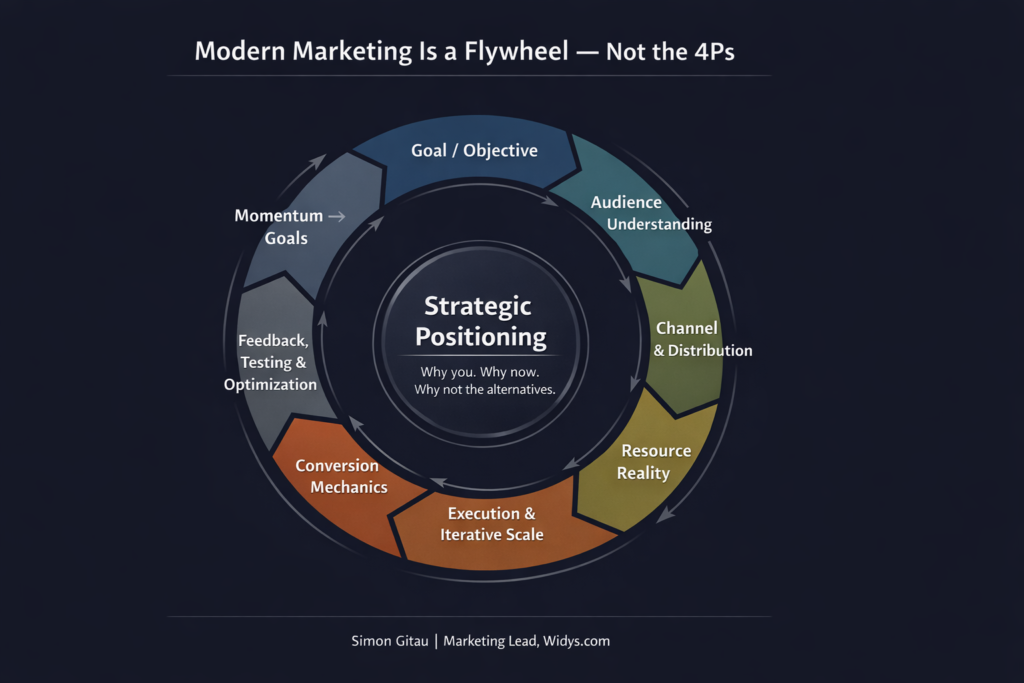
The Real Fundamentals of Modern Marketing (And Why the 4Ps Are No Longer Enough)
If you search for marketing fundamentals today, you’ll almost certainly be told the same thing:
Product. Price. Place. Promotion.
The 4Ps.
They’re not wrong — but they’re also not very helpful.
They were created for a different era: one with stable markets, predictable buyer journeys, limited channels, and far more control over attention. For anyone actively doing marketing today — especially in service businesses — they often feel disconnected from reality.
Modern marketing doesn’t fail because people don’t know the 4Ps. It fails because teams jump into tactics without a working system for how marketing actually creates results today.
This article lays out a practical, evergreen view of marketing fundamentals — not as theory, but as a decision-making framework that works in the real world.
Why Traditional “Fundamentals” Fall Short
The 4Ps focus on managing an offering. Modern marketing is about earning attention, building trust, and guiding decisions.
Today:
- Buyers self-educate long before they talk to anyone
- Trust matters more than polish
- Distribution often beats differentiation
- Feedback is constant, not quarterly
In this environment, marketing fundamentals should answer one core question:
How do we consistently move the right people from unaware → convinced → converted, using the resources we actually have?
That requires a different foundation.
What Marketing Fundamentals Should Actually Do
A modern set of fundamentals must:
- Start with intent, not tactics
- Respect real-world constraints
- Work across industries and business sizes
- Adapt as markets and channels change
- Create a feedback loop, not a one-way funnel
With that in mind, here is a practical framework for the true fundamentals of modern marketing.
The 8 Fundamentals of Modern Marketing
*(Often searched as marketing fundamentals or fundamentals of marketing, these principles apply to real-world service and contractor businesses today.)
1. Goal / Objective
Marketing activity without a clear objective is just motion.
Before choosing platforms, content, or campaigns, you must define:
- What are we trying to achieve?
- Awareness, trust, demand, conversions, retention?
Different goals require different approaches. Treating all marketing as “lead generation” is one of the fastest ways to waste effort.
If you can’t clearly state the outcome, you can’t measure progress.
Practical example for contractors and service businesses:
- A new business may focus on local awareness and credibility
- A busy business may focus on better-quality leads, not more volume
- A growing team may focus on predictable demand
Clear goals turn marketing fundamentals into measurable action.
2. Audience Understanding
Targeting is not understanding.
Knowing who you want to reach is the starting point. Understanding:
- What problem they are already trying to solve
- What they are skeptical about
- What they value, fear, or avoid
…is what actually shapes effective messaging.
Most marketing fails not because it’s invisible, but because it feels irrelevant.
Practical example:
- Homeowners care about trust, disruption, and cost certainty
- Commercial clients care about timelines, compliance, and reliability
- Emergency services buyers care about speed and reassurance
Marketing fundamentals work best when messaging mirrors real buyer concerns.
3. Strategic Positioning
Positioning answers three critical questions:
- Why you?
- Why now?
- Why not the alternatives?
This step is often skipped — and the result is marketing that sounds generic, even when the business itself is strong.
Without clear positioning, scaling marketing simply scales confusion.
Practical example:
- What makes your service safer, faster, clearer, or more reliable?
- What do you do that competitors avoid or overlook?
- What proof backs up your claims?
Strong positioning is a core pillar of modern marketing fundamentals.
4. Channel & Distribution Choice
Channels are not strategies. They are delivery mechanisms.
This step asks:
- Where does our audience already pay attention?
- Where does trust transfer fastest?
- Where can we show up consistently?
Being “everywhere” is not a requirement. Being reliable in the right place matters far more.
Practical example:
- Local search and Google Business Profiles for intent-driven buyers
- Short videos for trust and education
- Email or remarketing for nurturing
Choosing the right channels is a practical application of marketing fundamentals.
5. Resource Reality
This is one of the most overlooked fundamentals of marketing.
Every marketing plan must account for:
- Budget
- Skills
- Tools
- Time
- Operational capacity
Ambitious strategies that ignore constraints rarely execute well. Sustainable marketing starts with honesty about what is actually available.
Practical example:
- One skilled person with a phone can outperform a large but inconsistent team
- Simple tools used consistently beat complex stacks used rarely
Resource awareness keeps marketing fundamentals grounded in reality.
6. Execution & Iterative Scale
Marketing does not start fully formed.
You begin with what you have, prove what works, and then expand.
- Consistency beats intensity
- Evidence beats assumptions
- Scale follows traction, not plans
This mindset turns marketing into a learning process rather than a gamble.
Practical example:
- Start with one channel and one content format
- Improve based on response
- Add volume or platforms only after results appear
Execution is where marketing fundamentals become visible.
7. Feedback, Testing, and Improvement
Marketing is not a one-way broadcast. It is a loop.
This includes:
- Paying attention to engagement signals
- Identifying drop-offs
- Testing messaging, formats, and offers
You don’t need complex dashboards to improve marketing — you need to listen carefully and adjust deliberately.
Practical example:
- Which videos get watched fully?
- Which pages generate calls?
- Where do inquiries stall?
Feedback closes the loop on marketing fundamentals.
8. Conversion Mechanics
Attention without conversion is entertainment.
Conversion is not a button. It’s the result of:
- Clear next steps
- Reduced friction
- Trust at the moment of decision
- Message alignment with intent
Every marketing effort should make it easier for the right person to take the next logical step.
Practical example:
- Clear calls to action
- Simple contact paths
- Proof near decision points
Conversion mechanics complete the fundamentals of marketing.
Frequently Asked Questions About Marketing Fundamentals
What are marketing fundamentals?
Marketing fundamentals are the core principles that guide how businesses attract attention, build trust, and convert customers. In modern contexts, marketing fundamentals focus less on theory and more on execution, feedback, and outcomes.
Are the 4Ps still relevant?
The 4Ps are still useful for managing products and offerings, but they are not sufficient as standalone marketing fundamentals today. Modern marketing requires audience understanding, positioning, distribution, and iteration.
What is the difference between traditional and modern marketing fundamentals?
Traditional fundamentals emphasize products and promotion. Modern marketing fundamentals emphasize goals, audience behavior, channels, resources, execution, and continuous improvement.
Do marketing fundamentals apply to small businesses and contractors?
Yes. In fact, service businesses benefit the most from strong fundamentals because they operate with limited resources and rely heavily on trust and reputation.
How long does it take for marketing fundamentals to work?
Fundamentals are not tactics. When applied consistently, they create compounding results over time rather than short-term spikes.
This Is a System, Not a Checklist
These fundamentals don’t work in isolation.
They form a loop:
- Goals shape targeting
- Targeting informs positioning
- Positioning guides channels
- Channels are limited by resources
- Execution generates feedback
- Feedback improves conversion
- Results refine goals
Skipping steps doesn’t save time — it creates waste.
The Bottom Line
Marketing hasn’t become more complicated — it has become more honest.
The fundamentals are no longer about memorizing frameworks. They are about making disciplined decisions under real constraints, guided by feedback and focused on outcomes.
The 4Ps still have their place. But they are not the foundation of effective marketing today.
A system built on goals, audience understanding, positioning, distribution, execution, and iteration is.
And that system is what allows marketing to work — consistently, sustainably, and in the real world.