

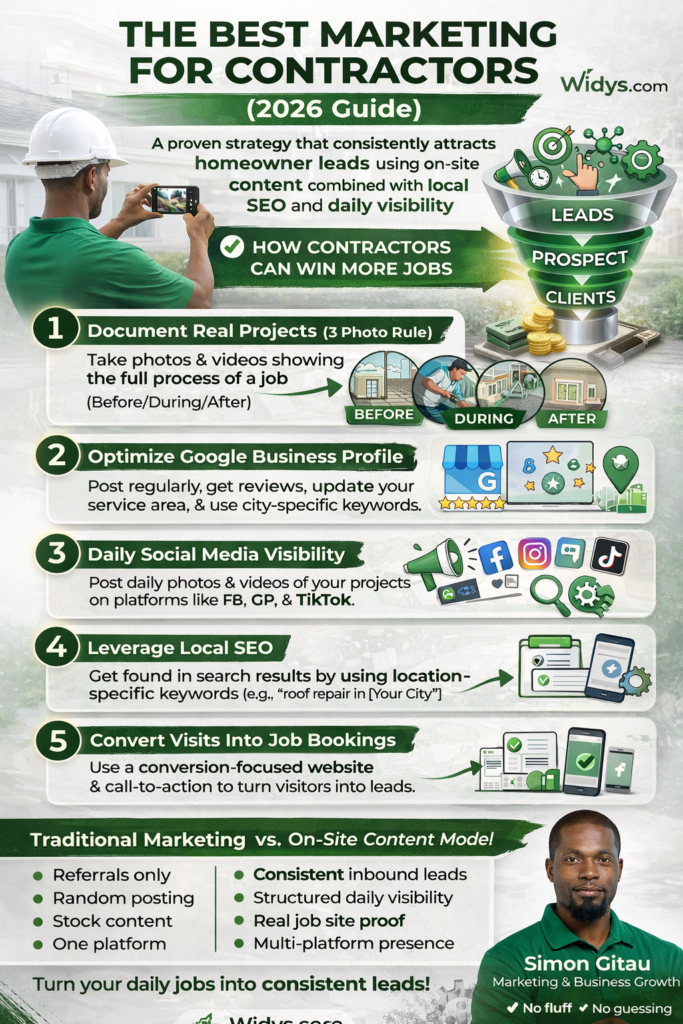
What is the best marketing for contractors?
The best marketing for contractors is a combination of on-site content, local SEO, and consistent visibility across multiple platforms.
Instead of relying only on referrals, contractors who document their daily work, publish it consistently, and optimize their online presence generate a steady flow of inbound leads from homeowners actively searching for their services.
What Is the Best Marketing for Contractors?
The most effective marketing for contractors today includes:
- On-site content (photos and videos of real projects)
- Google Business Profile optimization
- Local SEO (ranking in your service area)
- Social media visibility (consistent posting)
- Paid advertising (Google local service ads LSA and Meta for scaling)
- A conversion-focused website
Most contractors don’t struggle because they lack skill.
They struggle because no one sees their work consistently enough to trust them.
The Real Problem: Why Most Contractor Marketing Doesn’t Work
Let’s be honest for a second.
You might have:
- A good website
- Some social media posts
- Maybe even ran ads
But leads still feel inconsistent.
Why?
Because most contractor marketing today is built around:
- Waiting for referrals
- Posting occasionally
- Using generic content
- Working with agencies that never step on your job site
- Running ads
- Hoping the season is good
That creates a cycle:
👉 Busy → no marketing
👉 Slow → panic marketing
👉 Repeat
This is what keeps most contractors stuck.
The Shift: What Actually Works in 2026
The contractors who are growing right now are not doing more complicated marketing.
They are doing more visible marketing.
They’ve shifted from:
- “How do I get leads?”
To:
- “How do I make sure people see my work every day?”
Because the truth is simple:
People don’t hire the best contractor.
They hire the contractor they see the most and trust the most.
And trust is built through consistent exposure to real work.
The Widys Approach: The On-Site Content Model
At Widys, we’ve built our entire strategy around one simple idea:
Document your work. Don’t try to create marketing in an office.
This is what we call the On-Site Content Model.
Instead of staged content, scripts, or generic posts…
You use your actual projects as your contractor marketing.
Step 1: Document, Don’t Create
Every job you do already has everything you need for marketing.
You just need to capture it.
We follow a simple structure:
The 3 Photo Rule
Every project should include:
- Before (The Problem)
Show what needed to be fixed - During (The Process)
Show your team working, tools, materials, and care - After (The Result)
Show the finished outcome clearly
This alone builds more trust than 90% of contractor marketing online.
The 3 Video Approach
Video is even more powerful because it shows truth.
Simple clips like:
- Walking through a project
- Explaining what you’re doing
- Showing progress
These don’t need to be perfect.
They need to be real.
Step 2: Turn One Job Into 30+ Pieces of Content
This is where most contractors underestimate what they have.
One project can become:
- 1 main video
- 5–10 short clips
- 10+ photos
- 1 blog post
- 1 case study
- Multiple Google updates
That means:
👉 One job = weeks of marketing
You’re not creating content.
You’re multiplying what already exists.
Step 3: Daily Visibility = More Opportunities
There’s a reason this works.
Most homeowners don’t hire immediately.
They:
- Watch
- Compare
- Observe
- Come back later
It often takes 7–8 touchpoints before someone hires you.
If you only post once a week…
You’re invisible most of the time.
But if you show up daily:
👉 You stay top of mind
👉 You build familiarity
👉 You increase trust
And over time:
👉 People start reaching out without you chasing them
Step 4: Local SEO (Being Found When It Matters)
Content builds trust.
But local SEO makes sure people find you when they are ready to act.
This is where your Google presence matters.
What Local SEO Really Means
Local SEO is not complicated.
It’s simply:
Proving to Google (and people) that you are active, relevant, and trusted in your area.
What You Need to Focus On
- Google Business Profile updates
- Reviews (consistent and real)
- Location-based content
- Project uploads
- Service-specific keywords
For example:
Instead of:
👉 “Kitchen remodel”
You want:
👉 “Kitchen remodel in Nairobi West”
👉 “Bathroom renovation in Westlands”
This connects your work to real searches.
Step 5: Social Media That Actually Works for Contractors
Most contractors think social media doesn’t work.
The truth is:
👉 Generic social media doesn’t work
👉 Real project content does
What You Should Be Posting
- Before and after transformations
- Work in progress
- Team in action
- Client walkthroughs
- Quick explanations
Not:
- Quotes
- Stock images
- Random trends
People want to see proof, not inspiration.
Step 6: Your Website (Where Decisions Happen)
Your website is not just a portfolio.
It’s where people decide:
👉 “Do I trust this contractor?”
What Your Website Must Have
- Real project photos
- Case studies
- Clear services
- Strong location signals
- Easy contact options
And most importantly:
👉 It must match what people see on your content
Consistency builds confidence.
Step 7: Paid Ads (Scaling What Already Works)
Ads are not where you start.
They are where you scale.
When Ads Work Best
Ads perform best when:
- You already have content
- You already have proof
- You already have visibility
Then ads:
👉 Amplify what’s working
👉 Bring faster results
👉 Fill your pipeline quicker
Without that foundation, ads feel expensive and inconsistent.
Traditional Marketing vs What Works Today
| Traditional Contractor Marketing | What Works Today |
| Referrals only | Consistent inbound leads |
| Occasional posting | Daily visibility |
| Stock content | Real job site proof |
| One platform focus | Multi-platform presence |
| Reactive marketing | Consistent exposure |
The difference is simple:
👉 One waits for opportunities
👉 The other creates them
Proven Results: From Inconsistent Jobs to Predictable Growth
We worked with a contractor who was doing around $100k/year in San Antonio.
Good work. Strong experience.
But inconsistent leads. The Client is now doing over $1,350,000 with less than three years of content marketing, on-site content curation, social media, website, google business profile, and SEO.
What Changed
We implemented:
- Daily on-site content
- Consistent posting
- Local SEO improvements
- Better visibility across platforms
The Results
- Year 1 → ~$300k
- Year 2 → ~$700k
- Year 3 → ~$1.3M+ projected
Not because of tricks.
But because:
👉 More people saw the work
👉 More people trusted the work
👉 More people reached out
What Is the Best Marketing Strategy for Contractors in 2026?
If you simplify everything, the best marketing stack looks like this:
1. Content (It Is the Core Driver of the best marketing for contractors today)
Daily visibility using real work
2. Google Presence (It is the Primary Discovery Layer of Local Service Businesses)
Being found when people search
3. Website (Almost every client visits your website to convert. It is the Conversion Layer)
Turning interest into inquiries
4. Ads (Scaling Layer)
Accelerating growth and increasing essential customer journey tough points.
How Much Should Contractors Spend on Marketing?
Most contractors ask this.
The better question is:
👉 “How serious are you about growth?”
A Practical Model
We often recommend:
- ~$3,000/month for marketing support
- ~$3,000/month internally for content capture
Total: ~$6,000/month investment
Why This Works
Because:
- You’re building long-term visibility
- You’re not relying on luck
- You’re creating consistent demand
And over time:
👉 The cost per lead drops
👉 The quality of clients improves
Frequently Asked Questions of The Best Marketing For Contractors
What is the most effective marketing for contractors?
The most effective marketing is consistently showing real work through content while optimizing your local presence so homeowners can find and trust you easily.
How do contractors get more leads?
By increasing visibility. The more often potential clients see your work, the more likely they are to contact you when they need your services.
Is social media worth it for contractors?
Yes, but only if it shows real projects. Social media works when it builds trust through proof, not generic posts.
How long does contractor marketing take to work?
Most contractors start seeing momentum within 60–90 days of consistent visibility, with stronger results building over 6–12 months.
Final Thought: The Problem Is Not Your Work
If you’re a contractor doing solid work but not getting consistent leads…
It’s not your skill.
It’s your visibility.
Let’s Be Honest for a Second
Right now, you probably have:
- Active projects
- Good results
- Happy clients
But…
👉 How many people actually see that consistently?
What Happens When You Fix That
When you:
- Document your work
- Show up daily
- Stay visible
You move from:
👉 Chasing jobs
To:
👉 Attracting opportunities
Work With Widys
We help contractors turn their daily work into consistent inbound opportunities.
No fluff.
No guessing.
Just real work, shown the right way.
👉 If you have a project right now and nobody knows you’re behind it…
That’s the problem.
Fix that.