
How to Get Leads That Convert in 2026
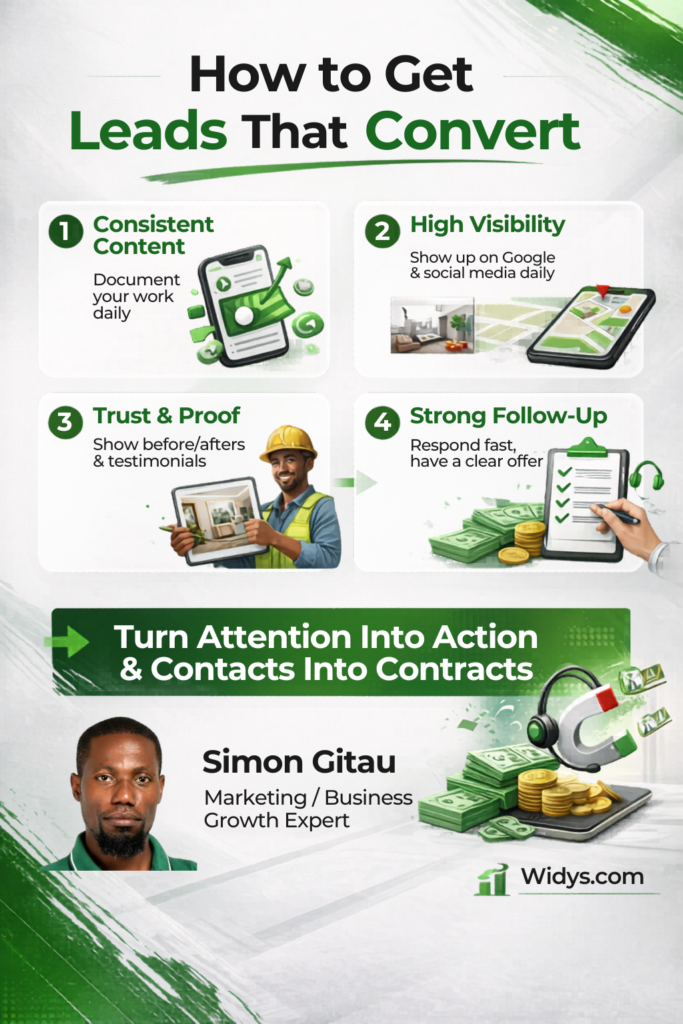
How to Get Leads (The Real Way Contractors Win Clients Today)
If you’re a contractor or construction company…
You’ve probably asked yourself:
- Why do some contractors always have projects lined up?
- Why do others struggle—even when they do great work?
- And more importantly…
👉 How do you actually get leads consistently?
Because here’s the truth:
Getting leads is not about luck.
It’s not about referrals.
And it’s definitely not about posting randomly on social media.
👉 It’s about visibility, trust, and consistency.
In this guide, we’ll break down:
- How to get leads (step-by-step)
- How to get clients as a contractor
- How to build a predictable pipeline in construction
What Is a Lead (And Why Most Contractors Misunderstand It)
A lead is:
👉 Someone who has shown interest in your service
But not all leads are equal.
Types of leads:
- Cold leads → Don’t know you yet
- Warm leads → Aware, comparing options
- Hot leads → Ready to hire
Most contractors fail because they only rely on:
👉 Hot leads (referrals)
Instead of building a system that:
- Attracts cold
- Educates warm
- Converts hot
What a Lead Actually Looks Like in Construction
In construction, a lead is not just a “form fill.”
It could be:
- A homeowner saving your video for later
- Someone asking for your contact in the comments
- A developer visiting your website multiple times
- A referral who checks your Instagram before calling
👉 This is important because…
Most contractors think:
“If I didn’t get a call, I didn’t get a lead.”
But in reality:
👉 Leads start forming long before they contact you
They:
- Watch your work
- Compare you silently
- Build trust over time
By the time they call…
👉 They’ve already chosen you mentally
The 3 Core Ways to Get Leads (Simple Framework)
Every lead generation strategy falls into 3 categories:
1. Inbound (People find you)
- Google (SEO)
- Social media
- YouTube
- Website
2. Outbound (You find them)
- Ads
- Cold outreach
- Partnerships
3. Owned attention (You stay top of mind)
- Retargeting
- Content
👉 The winners combine all three.
Why Most Contractors Only Use One (And Lose Because of It)
Most contractors rely on just one source:
👉 Referrals
And while referrals are powerful…
They are:
- Unpredictable
- Hard to scale
- Not in your control
This creates what many contractors experience:
👉 Busy months → Dry months → Panic → Repeat
Instead, think of your lead sources like this:
- Referrals = bonus
- Marketing = control
When you combine inbound + outbound + owned attention…
👉 You create stability
How to Get Clients as a Contractor (The Widys Way)
This is where most advice breaks.
Because generic marketing doesn’t work for construction.
The reality:
People don’t hire contractors based on ads.
They hire based on:
- Proof
- Trust
- Visibility
How Homeowners Actually Choose a Contractor Today
Before hiring you, most clients will:
- Search your name on Google
- Check your social media
- Look at your past projects
- Compare you with 2–3 other contractors
Now ask yourself:
👉 What do they see?
- A few random posts?
- An outdated page?
- Or a strong portfolio of real work?
Because this is where decisions are made.
Not during the call.
👉 Before the call even happens.
The Shift (Important)
Old way:
- Referrals
- Word of mouth
- Waiting
New way:
👉 Document your work daily
The 6-Step Lead Generation System for Construction Companies
Step 1: Document Your Work (Not Create Content)
Instead of thinking:
“What should I post?”
Think:
👉 “What are we already doing today?”
Capture:
- Before (problem)
- During (process)
- After (result)
What to Capture on Every Project (Simple Checklist)
To make this practical, every site visit should capture:
1. The Problem (Before)
- What was wrong?
- What needed fixing?
2. The Process (During)
- Your team working
- Tools and materials
- Clean setup and professionalism
3. The Result (After)
- Final outcome
- Clean, finished look
- Happy client (if possible)
👉 This is what we call:
The 3 Photo / 3 Video Rule
Because each project should give you:
- Multiple posts
- Multiple angles
- Multiple opportunities to be seen
Step 2: Turn Work Into Content
From one project, you create:
- 5–10 short videos
- 10+ photos
- 3–5 posts
👉 Content marketing works because it:
- Educates
- Builds trust
- Attracts ideal clients
Step 3: Publish Daily (This Is Where Most Fail)
Consistency beats quality.
Why?
Because:
- Buyers need 7–8 touchpoints before hiring
- More visibility = more chances to win
What Happens When You Don’t Post Consistently
When you post randomly:
- People forget you
- Your competitors take attention
- Your visibility drops
But when you show up daily:
- You stay top of mind
- You build familiarity
- You increase trust
And here’s the key:
👉 People don’t hire the “best contractor”
👉 They hire the one they see the most and trust
Step 4: Be Everywhere Your Clients Are
You should show up on these social media platforms because a huge chunk of your customer base spend a lot of time here:
- TikTok
- YouTube
👉 Not randomly
👉 Strategically
Step 5: Capture Leads Properly
Your website must:
- Educate
- Build trust
- Capture contacts
Because:
👉 A lead generation website should both inform and collect contact details
What a High-Converting Contractor Website Looks Like
Your website should answer 3 questions immediately:
- What do you do?
- Who do you help?
- Why should I trust you?
Then it should guide the visitor to:
- Call you
- Message you
- Request a quote
Simple improvements that increase conversions:
- Real project photos (not stock images)
- Clear service pages
- Testimonials and proof
- Easy contact buttons
👉 If your website is confusing…
You lose leads silently.
Step 6: Convert (Most Miss This)
Leads don’t convert because of:
- Bad follow-up
- No clear offer
- No urgency
You need:
- Clear next steps
- Fast response
- Strong positioning
Best Lead Generation Strategies for Construction Companies
1. Content Marketing (Your #1 Asset)
- Daily project posts
- Case studies
- Before/after transformations
👉 This builds trust faster than ads
2. Google (SEO + Local SEO)
Rank for:
- “contractor near me”
- “kitchen remodel [city]”
👉 This brings ready-to-buy leads
3. Social Media (Organic + Paid)
- Organic → trust
- Paid → reach
Together = dominance
4. Paid Ads (Speed)
- Google Ads
- Facebook Ads
👉 Instant visibility
5. Referrals (But Smarter)
Don’t rely on them.
Instead:
👉 Amplify them with content
How to Get Clients in the Construction Business (Step-by-Step)
If you’re starting or trying to grow, here’s a simple path:
Step 1: Start documenting your work immediately
Step 2: Post consistently for 30–60 days
Step 3: Optimize your Google Business Profile
Step 4: Build a simple but clear website
Step 5: Run small targeted ads to boost visibility
👉 This combination gives you:
- Short-term leads (ads)
- Long-term leads (content + SEO)
How to Get Clients for a Construction Company (Common Situations)
If You’re Just Starting Out
Focus on:
- Documenting every small project
- Building your online presence
- Getting your first testimonials
👉 Don’t wait to “look big”
Start showing your work now.
If You’re Stuck Around $300k–$500k
You likely have:
- Good work
- Some referrals
- No consistent visibility
Your focus should be:
- Daily content
- Strong branding
- Expanding reach
If You Want Premium Clients
Higher-value clients look for:
- Professional presentation
- Strong portfolio
- Consistent visibility
👉 They don’t choose the cheapest
They choose the most trustworthy.
Why Most Contractors Struggle to Get Leads
- Inconsistent marketing
- No visibility
- No trust-building content
- No system
The Hidden Problem (Nobody Talks About This)
Most contractors are actually good at their work…
But invisible online. They don’t do any digital marketing for contractors.
And in today’s market:
👉 If people can’t see you
👉 You don’t exist to them
This is why:
Less experienced contractors
Often get more jobs…
👉 Because they are more visible
How to Get More Clients for Your Construction Business (Real Example)
One contractor:
- Was doing ~$100k/year
- No online presence
Then:
- Started documenting projects
- Posted daily
- Built visibility
Results:
- $700k → $1.3M → $2.5M pipeline
👉 Not luck
👉 Visibility
The Real Answer to “How to Get Leads”
It’s not:
- Ads
- SEO
- Social media
It’s:
👉 Consistency across all channels
How to Get More Clients for Construction Business
If you take nothing else from this guide, remember this:
Getting clients is not about one tactic.
It’s about:
- Showing your work
- Being consistent
- Building trust daily
Do this long enough…
👉 And leads stop being a problem
The Widys.com Approach
We don’t just “market”
We:
- Capture your real work
- Turn it into content
- Distribute daily
- Optimize for SEO, AEO, GEO
- Convert attention into leads
Final thought of getting the right clients for your business
If people don’t see your work…
👉 They cannot hire you
Ready to Get Consistent Leads?
If you’re a contractor doing $300k+ and want:
- More visibility
- Better clients
- Predictable pipeline
👉 Let’s build your lead flow
13 Practical Strategies for the Every General Contractor
If you are a general contractor, you’ve probably heard that you need to “go after the luxury market” to make real money. But here is the truth: the backbone of the American construction industry isn’t the 1%—it’s the average homeowner, the local landlord, and the neighborhood flipper.
Learning how to get leads for your construction company doesn’t require a Hollywood marketing budget. It requires a strategy built on trust, proximity, and practical solutions.
In this guide, we’ll break down 13 actionable ways to find the right clients and keep your crew busy year-round.
1. Focus on “Neighborhood Batching”
The most efficient way to learn how to get clients as a general contractor is to look at the houses right next to your current job site. Average neighborhoods are often built in waves, meaning if one homeowner’s deck is rotting, the entire street has the same problem.
Offer a “Neighborhood Batching” discount. Tell neighbors that since your trucks and tools are already on their street, you can waive the “mobilization fee” if they book their repair the same week. It’s a win-win: they save money, and you save on fuel and travel time.
2. Leverage “Home Health Checkups”
High-quality leads aren’t always looking for a full remodel. Sometimes, they just want to make sure their house is safe. Offer a $99 “Annual Home Health Checkup.”
Walk the property and check for water leaks, roof integrity, and safety hazards. Provide a simple “Green/Yellow/Red” report. This positions you as the “Family Doctor” for their home. When the “Yellow” items eventually turn “Red,” you’ll be the only person they call for the big job.
3. Partner with Local Property Managers
If you want to know how to get remodel company clients with high consistency, look at local landlords. Small-scale property managers (who handle 5–20 units) are goldmines. They value speed and reliability over the lowest bid. Help them with fast “unit turnovers” so they can get tenants back in quickly, and you’ll have a client for life.
4. The “Working Nearby” Proximity Play
Homeowners in middle-class suburbs are observant. Before you start a project, leave a note for the five houses on either side. Mention that there might be extra noise and provide your cell phone number in case your trucks are in the way. This professional courtesy proves you are a “neighbor-friendly” contractor before they even see your work.
5. Be the “Insurance Agent’s” First Call
When a pipe bursts, the homeowner calls their insurance agent, not Google. Visit local agents and offer to be their “Emergency Response” partner. If you can provide the specific line-item estimates that insurance adjusters need, the agents will keep sending you quality construction company leads because you make their job easier.
6. Target “Post-Inspection” Repairs
Every home sale generates a “Fix-It” list. Reach out to local home inspectors. They can’t officially recommend you for a kickback, but they can hand out your “Inspection Response Checklist.” By specializing in the 10–15 items that usually fail an inspection, you become an essential part of the local real estate ecosystem.
7. Master the “Pro-Desk” Referral Engine
The guys at the lumber yard and flooring store see every contractor in town. They know who pays their bills and who does good work. Don’t just ask them for leads—send your customers to them first. When you build a reciprocal relationship with the “Pro-Desk,” they will naturally mention your name to overwhelmed homeowners.
8. Dominant Local “Era” Specialization
Every era of homebuilding has its flaws. Whether it’s 1950s Ranches or 1920s Bungalows, become the specialist for a specific build style. When you can tell a homeowner, “I know exactly where the plumbing stack is in this model because I’ve worked on ten of these,” you instantly become the right client choice.
9. Utilize Thermal Imaging for “Energy Leaks”
In an average neighborhood, energy bills are a major pain point. Use a thermal imaging camera to show homeowners where they are losing heat or AC. Seeing a “purple” cold spot on a screen makes the need for new insulation or window seals undeniable. It’s a high-tech way to build trust through visual proof.
10. The Facebook Community Expert Strategy
Don’t just post ads in local Facebook groups. Instead, answer questions. When someone asks why their drywall is cracking, give them the technical answer for free. By being a “community resource” rather than a “salesperson,” you build the social equity needed to land high-value contracts.
11. Hyper-Local SEO: Solving “Average” Problems
When learning how to get the right clients, focus on what they are searching for. They aren’t searching for “Architectural Marvels.” They are searching for “[City] deck repair cost” or “How to fix a damp basement in [Town].” Create simple “problem-solving” pages on your website to capture these specific, local searches.
12. Small-Scale “Investor” Partnerships
Look for the local “house flipper” doing 1–2 projects a year. These investors need a partner who understands “Investor-Grade” finishes—durable, clean, and fast. Offer to walk through a potential purchase with them to provide a feasibility estimate. Your expertise helps them make money, ensuring they keep you on their payroll.
13. The “Review & Referral” Maintenance Loop
The best lead is the one you’ve already won. Six months after a job, send a simple text checking in on your work. This small gesture often triggers a “Oh, actually, my neighbor was just asking about you!” moment.
Summary: Building a Sustainable Lead Engine
Knowing how to get leads as a general contractor isn’t about chasing the biggest budget; it’s about being the most reliable professional in your specific neighborhood. By focusing on these 13 practical strategies, you can build a business that is resistant to market shifts and packed with high-quality, local clients.